In the area around Tadoba National Park, conservation is part of daily life. It is not seen as something separate. Sudeep Mehta (42), who used to work in finance, and his father Sunil Mehta (68) are leading this effort. Sunil developed an interest in working for the environment many years ago. He and his son believe that forests will only be protected if people who live around them benefit directly. If people do not have a steady income, conservation will not be possible for long. When income is irregular, people will struggle to survive.
This kind of thinking gave birth to “The Bamboo Forest Experience” located near Tadoba National Park in the state of Maharashtra. It is an eco-tourism project that ties together wildlife preservation, sustainable tourism, and employment. It is designed as an operation where the preservation of nature and the enhancement of local income are achieved simultaneously.
The Bamboo Forest Experience Near Tadoba National Park
The Bamboo Forest Experience consists of a number of different projects. Bamboo Forest Safari Lodge in Tadoba National Park is the primary place for guests’ stays. Camp Alizanza stands close to a buffer zone entry gate of the park. It serves as a conservation & community facility. The Bamboo Forest Nature Conservancy in Gothangaon is 65 kilometers from Nagpur. It is an extension of the environmental work.
The design of the accommodation is simple but well-thought-out. The tree houses are placed 20 feet high. This was the preferred height because of safety and stability considerations. It was advised by the local community that structures would be stable even in strong winds because some parts of the trees would stay steady in such conditions. Their construction includes bamboo, mud materials, and locally collected wood.
These materials reduce environmental impact & support traditional construction methods. Guests can watch wildlife without large concrete structures. Among hotels in Tadoba, this project stands out because of its focus on sustainability and strong local participation. Most employees are from nearby villages. Food & supplies are bought from local sellers whenever possible. Conservation is part of daily operations, not a separate activity.
The Problem Before The Project Started
Before this model began, villages near Tadoba National Park faced serious economic challenges. Hunting & woodcutting provided income for many Adivasis. Poaching of wild boar, sambar deer, & chital happened frequently. In many cases, families hunted because they needed food or money.
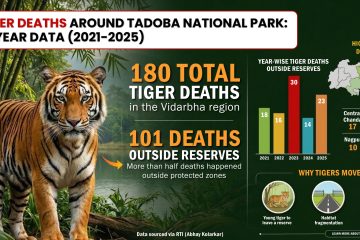
Man-animal conflict was high. Between 1 January & 19 September 2025, 30 people died due to tiger attacks in the Tadoba region, according to data reported by The Hindu from Chandrapur forest officials. Many families were afraid to enter forest areas. Livestock losses were common, which increased financial stress.
Agriculture was also difficult. Land near the forest was affected by monsoon floods. Most farmers could grow only one crop per year. Income from farming was low & uncertain.
Because of these problems, many local residents did not support tiger conservation. For them, wildlife brought danger & financial loss. There was no clear benefit from protecting animals.
COCOON Model: Community Owned Community Operated Nature Conservancy
To address these problems, the Mehtas created the COCOON model, which means Community Owned Community Operated Nature Conservancy. This model gives local people shared ownership & responsibility in conservation work.
The plan focuses on re-wilding farmland located on animal movement routes. Instead of removing local people from these areas, the model includes them as partners. Income from tourism is directly linked to conservation results. When conservation improves, local income also improves.
Camp Alizanza was the first place where this model was implemented. Around 200 families are directly connected to it. Many families now earn in about two & a half months what farming took a year before.
About 90 percent of the community receives income from this initiative. People work as safari drivers, forest guides, chefs, gardeners, housekeeping staff, and reception personnel. Different types of work provide a steady income to families.
Farming has not stopped. Farmers grow fruits & vegetables & supply them to the lodge kitchens. This supports local supply chains & traditional farming. At the same time, environmental conditions have improved. Poaching has reduced. Some degraded lands have been restored. With stable income, many residents now see conservation as financially beneficial.
Earlier Success In Jaipur & Awards
The work near Tadoba National Park is based on previous experiences. Sunil Mehta passed the civil services examination in 1980 but did not join the police service due to health reasons. He then decided to work on environmental restoration. Near Jaipur, an area of 400 acres of barren land was converted into productive land with the help of local villagers.
Sunil Mehta’s team used rainwater harvesting as the main technique for this project. They built an 800-meter canal to manage rainwater from the Aravalli hills. They also used traditional water management methods. Over time, groundwater levels rose, dry wells received water again, and farmers started growing three crops instead of one.
By 2010, trees, vegetation, & animals had grown. Everyone contributed to improving the soil step by step. They added leaves for nutrition and added water slowly. The team also used mulching to keep moisture in the soil. They added sun-dried cow dung to improve soil fertility and support healthy plant growth. In the year 2007, the Rajasthan government awarded Sunil Mehta the Jal Mitra Award for water conservation & the Gram Bandhu Award for community involvement.
Long-Term Impact On Tadoba National Park And Local Communities
In the year 2011, Sudeep Mehta quit his job in London & joined his father’s work. In around 2019, biodiverse land was located around Nagpur. This led to the development of The Bamboo Forest Safari Lodge around Tadoba National Park. He and his team planted around 5,000 bamboo trees and made a clear agreement with local people.
Mr. Mehta would give local people gas connections if they stopped cutting trees for cooking fuel. Today, many local residents work as guides and animal trackers in Tadoba National Park, describing wildlife behavior and habitats. Handicrafts made of bamboo create extra income opportunities. There is a transfer of skills from the elderly to the younger generation.
Eco-tourism has helped to eliminate tiger poaching, as it has provided legal sources of income. Stable income has helped to eliminate negative attitudes towards tigers. This example proves hotels in Tadoba help tiger conservation efforts. Involving the community in conservation ensures the sustainability of conservation efforts. Environmental conservation & community development in Tadoba National Park go hand in hand with proper planning.

0 Comments