Tadoba-Andhari Tiger Reserve is a renowned wildlife reserve in the state of Maharashtra. It is often referred to as Tadoba National Park, too. It is an ideal place for Bengal tigers. Every year, a large number of tourists visit the place to enjoy a tiger safari in the Tadoba tiger reserve to catch a glimpse of the tigers and other animals in their habitat.
Earlier, tracking tigers in the forests was done by the forest guards, who used to look for tiger pugmarks on the forest roads and observe the behavior of the animals too. They used to listen to the alarm calls of the deer and langurs to detect if a tiger was near. Today, advanced technology such as camera traps, GPS, satellite systems, and data software is used to track the tigers in the forests, which helps the forest staff to do their jobs better and more safely.
Why Tiger Tracking Is Important In Tadoba National Park
Tadoba National Park is spread over 1,727 square kilometers. The reserve has dense forest, grassland, lakes, and buffer zones. There are several villages around the buffer zones. The people around the buffer zones depend on farming, livestock, and the forest for their daily earnings. Tigers are territorial animals.
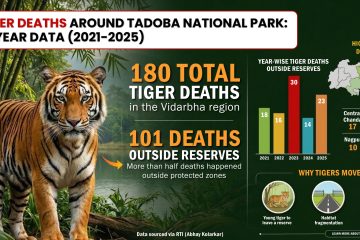
Every tiger requires its own territory for survival and hunting. When young tigers grow up, they move from the territory of their mothers and try to establish a new territory. During the movement, they may move from the forest area to the farming area or the village area. If the movement is not monitored properly, it may create a fear situation among the villagers.
Such problems can be avoided by regular and scientific tracking of the tiger movement in the Tadoba National Park. Forest officials know the location of the tiger movement, and this information can be passed on to the villages nearby. This way, the problem of sudden encounters between humans and wild animals can be avoided. It also increases the safety of the people going for a Tadoba safari, as the forest officials know the location of the wild animals.
Tiger tracking also helps prevent the problem of poaching, as the movement of the wild animals can be monitored, and any suspicious movement can be identified. Tracking also helps the authorities know the condition of the ecosystem, i.e., whether it is balanced or not. It is not only about the location of the tiger, but also about the entire ecosystem of the forest.
AI-Based Virtual Alert System Near Villages
Tadoba National Park launched a new AI-based alert system for villages that fall under the buffer zone of the forest in the year 2023-24. The Maharashtra Forest Department and the National Tiger Conservation Authority helped design this project carefully from the start. The main aim of this project is to reduce the conflicts between wild animals and people, and also increase the security of the villages that fall under the buffer zone of the forest.
The forest staff also installed over 76 smart cameras at the village borders. The cameras use thermal sensors to detect the body heat of animals clearly. These cameras also have sound sensors that can identify the sounds of the animals. AI connects to these cameras and identifies animals such as tigers, leopards, and sloth bears easily.
The system works on edge computing technology. It processes data inside the device and does not send it to a distant server. When a large animal comes near a village, the system quickly alerts forest officers on their mobile phones. In some villages, loudspeakers also start automatically to inform residents. Forest staff and Rapid Response Units receive alerts immediately, so they can act fast, prevent accidents, and reduce fear among villagers.
M-STrIPES And Smart Forest Patrolling
Tadoba National Park also uses a national monitoring system called M-STrIPES, which stands for Monitoring System for Tigers – Intensive Protection and Ecological Status. Many tiger reserves across India use this system. It helps standardize forest patrolling and wildlife monitoring in a structured way.
Forest guards carry GPS-enabled devices or use mobile applications while patrolling. They record their patrol routes in real time. This helps cover all areas of Tadoba National Park. Senior officers review patrol records and confirm that they monitor every area.
During patrols, guards record detailed observations. They document tiger pugmarks, scat samples, and direct sightings. They also report illegal activities such as traps or snares. Guards also record information about waterhole conditions and the number of prey animals. They store all this data in a central database so they can analyze it and plan for the future.
In addition to ground patrols, Tadoba National Park has developed a cyber monitoring cell. A trained AI officer studies the collected data and analyzes movement patterns. This officer carefully examines seasonal wildlife changes. The officer also uses the data to assess risks like forest fires and animal movement trends.
This digital system improves forest protection and supports better decision-making. For visitors coming for a Tadoba safari, it creates a safer and more organized environment. For wildlife, it provides continuous monitoring and long-term protection.
Radio Collars And Satellite Monitoring Of Tigers
Researchers fit satellite radio collars on some tigers in Tadoba National Park. They usually collar young dispersing tigers or tigers that may enter high-risk areas so they can track and monitor them. The satellite radio collar sends the tiger’s location at regular intervals to the forest authorities. Satellite tracking also enables experts to understand the movement patterns of young tigers across different habitats.
It also enables experts to understand how young tigers use wildlife corridors that link the Tadoba National Park with other reserves such as the Pench Tiger Reserve and the Navegaon-Nagzira Tiger Reserve. Another important feature of this system is geofencing. It creates a virtual boundary around highways, farming areas, and the village. When a tiger with a collar crosses the virtual boundary, the system sends a message to the forest department officials.
The Rapid Response Team gets an instant alert and takes preventive actions to stop any conflict. This approach is also effective in avoiding accidents and the capture of animals unnecessarily. It also offers scientific support for wildlife research and management planning for the Tadoba National Park.


0 Comments